






 Trap
 Normal
Lightforce Sword
View:
875
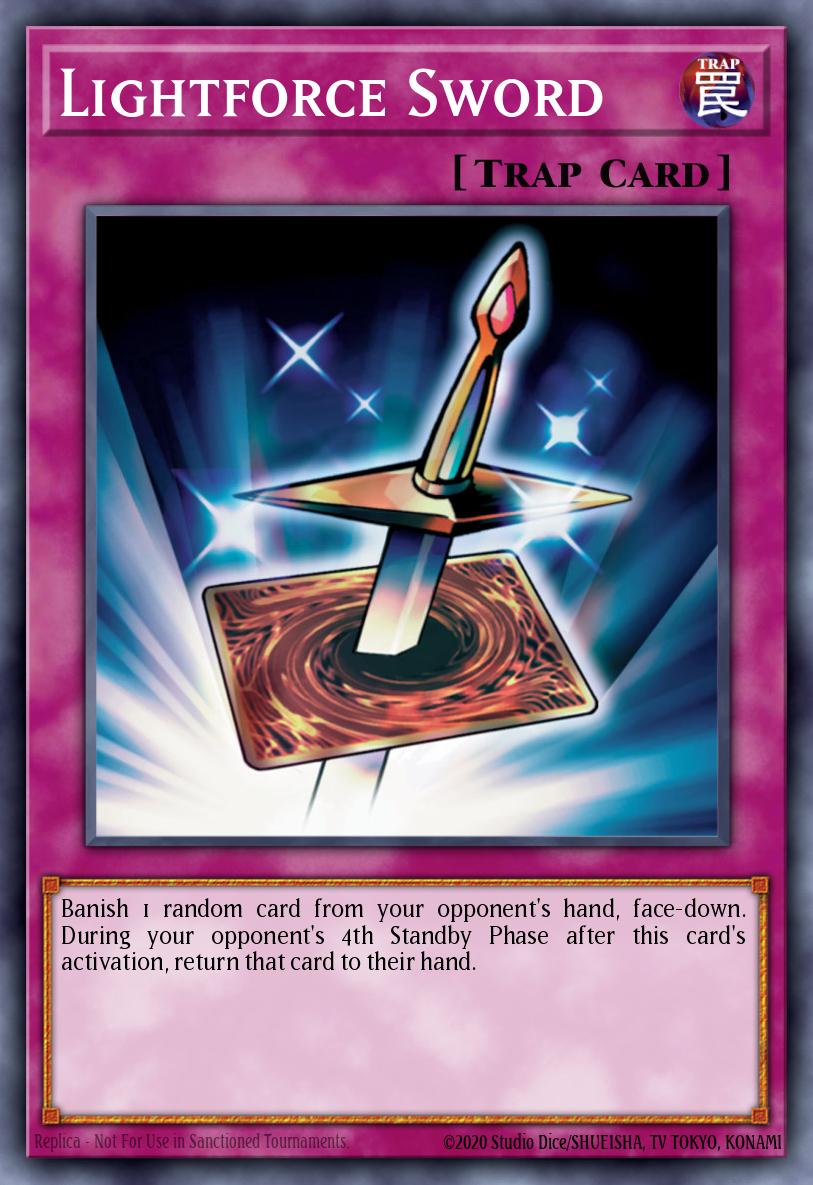
Banish 1 random card from your opponent's hand, face-down. During your opponent's 4th Standby Phase after this card's activation, return that card to their hand.

Lightforce Sword — Power Evaluation
Final Score: 56 ± 8 · Confidence: Medium
- Intrinsic: 55 · Deck: 56 · Meta: provisional
- Primary role: Removal / Negation · Secondary: Negation/Interaction
Why it scores here
Lightforce Sword is a trap whose value is temporary hand disruption: it banishes one random card from the opponent's hand face-down and returns it at the opponent's 4th Standby Phase. The text gives a clear, generic effect that 233 sampled decks across 52 archetypes run at about 1.84 copies, so it is practical and portable, which earns the accessibility and deckbuilding scores. Its randomness, delayed return and lack of any card advantage keep the interaction and conversion scores moderate, and the absence of combo and guide evidence caps confidence. High deck counts confirm that it is played, not that it is strong, so they were not used to raise the score.
Axis scores
| Axis | Score | Evidence |
|---|---|---|
| Accessibility | 55 | It is a set trap with no searcher or combo routes in the evidence; it reaches play through normal draws across many decks (decks_evidence, 233 decks, inferred plus observed). |
| Combo & Conversion | 25 | No combos_evidence exists, and the text converts nothing into board presence; the card only delays the opponent's hand (verified text, no combo data). |
| Resource Economy | 40 | It banishes one card from the opponent's hand and returns it later, so the net advantage is roughly even with no refuel or draw (inferred from text). |
| Effect & Interaction | 55 | The hand banish is random and temporary, so it is a soft interaction rather than strong removal, though it still denies one card for several turns (verified text). |
| Material Utility | 5 | A trap does not serve as Level, Attribute or material, so the card has no material body value (verified card type). |
| Resilience & Flexibility | 50 | It spans 52 archetypes and is redundant at up to 3 copies, but a face-down trap can be negated before it resolves (observed decks, inferred counterplay). |
| Deck-Building Efficiency | 80 | It is generic, cheap and splashable, and the only deck restriction is a single copy in Duel Links (verified legal_copies, observed decks). |
Calculation
Weight profile: Single primary role: Removal / Negation profile (no blend). Intrinsic ≈ 55, Deck ≈ 56, Meta = provisional. Modifiers: Limited to 1 (Duel Links) (-2). Final formula: 0.40*Intrinsic + 0.60*Deck
Strengths
- Generic hand disruption that fits many archetypes (52 distinct archetypes in the deck sample).
- Cheap, generic trap with near-free-roll deckbuilding cost.
- Delayed return makes the opponent lose access to one card for several turns.
Weaknesses
- Random target selection, so the disruption value depends on the opponent's hand.
- Return happens at a fixed later point, so it is a tempo effect rather than permanent removal.
- No combo or guide evidence to confirm how it performs in real boards.
Counters / choke points
- Negating the trap's activation before it resolves (inferred from the trap zone).
- Opponent plays through the banished card before the 4th Standby Phase return (inferred from the timed text).
Best use
Generic hand disruption trap in mid-to-late game interaction slots. Decks: Labrynth, Kashtira, Diabellstar, Scareclaw, Visas Starfrost, Tearlaments. Suggested copies: 1.
Evidence & gaps
- Verified: Card text: banishes 1 random card from the opponent's hand face-down and returns it at the opponent's 4th Standby Phase.; Card type is Trap Card, so it cannot serve as material.; legal_copies lists 1 copy in Duel Links; formats are TCG, OCG, MasterDuel and DuelLinks.
- Observed: 233 sampled decks run it, avg 1.84 copies (max 3), across 52 archetypes.; Most frequent gameplay type is 7 (60.1% of decks), with the top co-occurring partners at 46 to 65% of decks.
- Inferred: Role is hand disruption (Removal / Negation) based on text.; Net card advantage is roughly even because the banished card returns.; Negating the trap before it resolves is a counter.
- Data gaps: no combos supplied, so combo conversion and starter/searched/material shares are text-only inference no guides supplied no usage statistics (StatisticsCard) for archetype inclusion beyond the attached deck sample deck sample contains only decks that run the card, so inclusion rate against the full meta is unknown